
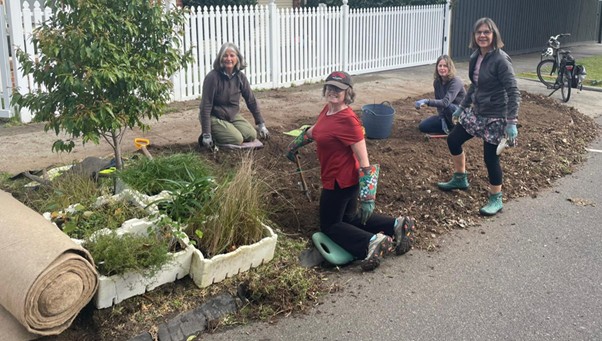
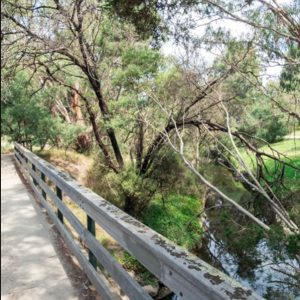
 The KooyongKoot Alliance (KKA) is expanding to reduce litter in our creeks. Can you help us grow?
Mark Landmann
The not-for-profit community-based organisation, KooyongKoot Allaince (KKA) comprises some 24 Friends Groups in the Gardiners Creek (KooyongKoot) Catchment. It has established a Clean Waterways Team to develop processes to reduce litter that flows via stormwater drains from streets to the creek into the Yarra River and ultimately Port Phillip Bay.
The Clean Waterways Team’s objectives are to develop replicable, ongoing litter and data collection programs on the ground throughout the catchment.
By replicable we mean that we are creating a template for reducing litter and pollution that can be broadly applied in many litter hotspots throughout our catchment. Litter hotspots are often shopping strips, industrial areas, sporting fields, or places near creeks in which litter accumulates.
Part of this template will be to work with communities, businesses and statutory bodies to implement targeted education programs to reduce litter at source.
Another important component is actual on-the-ground litter collection and recording of data. We have now registered NINE sites along or feeding into Gardiners Creek, from Blackburn Lake near the headwaters of Gardiners Creek, to lower Ashburton near Glen Iris.
What makes this on-the-ground work so meaningful – and, dare we say, exciting! – is that it fits neatly into the first funded Flagship Project in the brand new Gardiners Creek Strategic Plan. The Strategic Plan is a landmark document produced over some five years by the Gardiners Creek Regional Collaboration (GCRC), comprised of fourteen stakeholders including the KKA, five municipal Councils, Deakin University and Melbourne Water, with oversight by Wurrundjeri Traditional Owners.
A key recent step under this Flagship Project has been GCRC’s engagement of consultants to map the catchment’s main litter generation and accumulation hotspots, as well as various litter infrastructure and assets, in a cutting-edge Geographic Information System (GIS). This GIS is a live system which will receive litter and pollution data from groups like us for years to come.
So, while going out with a group of friendly, like-minded folks to collect litter and enter the data into an app is nice and simple, the beauty of our seat at the Collaboration and our access to the GIS is that our envisioned little army of de-litterers will not only rid our environment of litter, but in so doing will build a true map of these problems to give lawmakers every opportunity to make necessary institutional change in the future.
We’re pleased to have grown our network so we can collect litter on occasions at these nine sites and log the data in the Litter Stopper app. This is, however, just the beginning of our journey: we do need to build that little army of people working with the common aim of creating litter-free urban environments and, indeed, clean waterways.
Our initial efforts have just scratched the surface. For example, 30 kilograms of mainly soft plastic and small items and around 2000 cigarette butts were collected during our first five fortnightly cleans by a small band of volunteers at our shopping-strip ‘alpha-site’ in Box Hill. That’s 30 kilos of rubbish and 2000 cigarette butts that will never see our waterways, with lots more to follow.
If you are interested in our work in any way and/or would like to become involved in any capacity, please feel free to call Mark on 0408 354 070, Graham on 0407 046 358, or email cwsc@kka.org.au
Reducing the incessant accumulation of litter in our precious waterways requires us as a community to think and act both locally and holistically.
Nature Strip Revegetation
Sarah Brennan
Hawthorn and its surrounding suburbs are well known for their leafy streets and beautiful gardens. But like many cities, there is an underlying lack of biodiversity and native vegetation to accommodate our insects, reptiles and birds. But one initiative to help solve this crisis is nature strip revegetation, and that’s exactly what we’re doing at my apartment building.
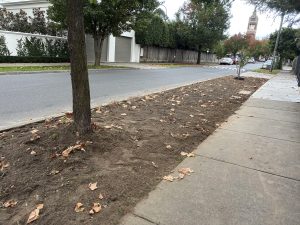 Months ago, our nature strip was in quite a sad state. Filled with weeds, grass and dirt, its use was to accommodate the bins, or for trucks to park on when delivering a package. As someone who is concerned about the environment, I saw the nature strip as an opportunity to try and make a positive difference in the community.
Myself and other interested tenants worked together and received approval from our apartment building’s committee to revegetate the nature strip. We successfully applied for a permit from the Boroondara Council to undertake the project, and received a voucher for 20 free plants from a local nursery.
For the revegetation we chose to work with KooyongKoot Alliance (KKA) as part of their ‘Rewilding our Nature Strips’ program. They provided invaluable guidance on the steps to rewild the verge and aided with establishing the best layout to work for the plants, tenants and the bins.
After getting the all clear with Before You Dig Australia (to ensure we wouldn’t hit any underground pipes or cables), the first step was to remove the topsoil of grass and weeds. We filled all of our green bins to the brim, and even though our backs ached, seeing the weeds removed was the beginning of this exciting project.
We let the exposed dirt sit for a month and then came the laying of the weed matting, thanks again to KKA. The jute matting had pre-cut slits for the plants and it was held in place with metal pegs.
KKA also provided additional plants which consisted of native wallaby grass, saltbushes, everlastings, and various flowers. In the layout we made sure to leave space for the bins and a generous walkway for the tenants who often cross the strip to get to the building. We ended up having to cut more slits into the matting to accommodate all the plants we had been given!
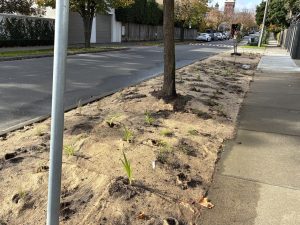 After applying a generous layer of mulch sourced from a local arborist, and carting it back to the building, the nature strip was done! We put down some pavers for finishing touches, and while the plants are small, we look forward to watching them grow over the next year, and all the pollinators they attract.
Through this process I’ve come to realise how much of a waste of space nature strips are. Grass doesn’t enhance biodiversity; it takes up valuable space that can be optimised for greater purposes.
If you’re considering rewilding your nature strip, I highly recommend working with a community group such as KooyongKoot Alliance or Balwyn Rotary to help with the process. Rewilding can be labor intensive, but it’ll be of significant benefit to your local environment and bring joy to those who walk by it.
Sarah Brennan is convenor of the Lighter Footprints Forests Working Group
Source of featured image: KooyongKoot Alliance https://kka.org.au/