

 Platypus spotting on the Yarra
ACF Eastern Rosellas
The Eastern Rosellas community group of the Australian Conservation Foundation (ACF) is an open and welcoming group of eastern suburbs people who work together where we can to protect our natural environment, and to influence those in power to rise to the urgent challenge of climate change.
The platypus is a truly fascinating animal. It is found only in Australia and is one of the five species of monotreme (egg laying mammals). The other four monotremes are species of echidna, one in Australia and three in New Guinea. The modern platypus has been around for 4 million years, and its direct ancestors were dinosaurs.
The platypus lives in burrows in the banks of freshwater rivers, lakes and creeks. It has webbed feet for swimming, but it walks on its knuckles when on land, to protect the webbing. Males have a venomous sting on each hind leg, probably used only in territorial disputes. In breeding season, the female normally lays two leathery eggs in the burrow, and lactates for the little nestlings (puggles) through its pores. Puggles leave the nest from about four months of age. Platypuses live on insects and other freshwater invertebrate bugs. They close both their eyes and ears underwater and, amazingly, hunt through electrolocation, sensing tiny currents from the muscle movements of bugs through thousands of receptors in their beak, and also through highly sensitive touch in their feet.
The platypus is listed as locally endangered in parts of its range, and is listed as vulnerable in Victoria. It is a resilient animal, but it needs clean and reliable water to thrive. Because of its diet of insects and bugs, it is at great risk from pesticide runoff. It is also at risk from extremes of water flow resulting from drought and flood exacerbated by climate change, and by land clearing, bushfire, dam building and urban development. The platypus can also be injured or killed by rubbish including fishing line and circular elastic or plastic, and by dogs. Water management bodies, Landcare groups and environmental organisations are working hard to monitor invertebrate numbers and protect water quality in platypus habitat.
We are fortunate to have several platypus colonies in outer metro Melbourne, around the upper Maribyrnong catchment, the Werribee River, creeks in the Dandenong Ranges, the upper Plenty River valley, and the Yarra and Little Yarra rivers. The ACF is sure from past visits that there is a platypus colony at Wombat Bend in Templestowe Lower. But it is always helpful, for platypus research, to record current sightings in that place, as it is anywhere they are sighted.
Our team is once again hosting a platypus spotting event on Saturday 19 September from 4:30 to 6:30pm at Wombat Bend in Templestowe Lower, and everyone is welcome. This event is part of the Platy Project, a joint citizen science campaign of the ACF and the University of NSW. The aim of the project is to assist in mapping platypus habitat, over time, across Eastern and Southern Australia.
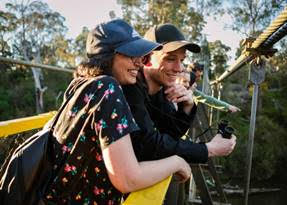
If you are able to be there on September 19, we’ll guide you to the University of NSW platypus recording site on your phone, and ask you to pick a comfortable and safe spot along the river bank or on the swing bridge, and watch. The platypus is nocturnal, and it starts to forage towards dusk, earlier on cloudy days. They usually dive for about 30 seconds and surface for 10-15 seconds at a time, so you need a bit of patience and persistence to see them. But it is restful to sit quietly by a river at sunset, watching the water and listening to the birds. And it’s a memorable experience if you see a platypus, especially for the first time and especially for the kids.
Please join us in this project if you’re interested and free that day. For more information and to register, please visit https://community.acf.org.au/eastern_rosellas_vic_platy_project_yarra_at_templestowe_2026
 Platypus in KooyongKoot (Gardiners Creek)? Can we return the Platypus to Gardiners Creek (KooyongKoot)?
Graham Ross and Geoff Williams
Gardiners Creek (KooyongKoot) is a significant tributary of the Yarra River that flows through a highly urbanised landscape. Various initiatives have recently been announced to restore environmental values along the creek. These include the formation of the KooyongKoot Alliance, in which 20 Friends Groups are cooperating to act as a collective voice for the creek and its tributaries.
The alliance is working collaboratively with Stonnington, Whitehorse, Monash and Boroondara Councils, Melbourne Water, Deakin University and a number of sporting and community organisations to develop a Strategic Masterplan for this important community asset. This Plan will ultimately commit to a more holistic approach to managing the Creek and realizing its true potential.
This raises an intriguing possibility: could Gardiners Creek one day be home to the world’s strangest mammal, the platypus?
Director of the Australian Platypus Conservancy, Geoff Williams, said that returning the platypus to KooyongKoot would be a huge challenge but there were many positives associated with attempting to re-establish a population of this monotreme.
“The platypus is a key species in freshwater eco-systems,” said Geoff. “If you can make environmental conditions good enough to support a platypus population then you are pretty much getting things right for all the other species, both big and small, that live in such habitats. In addition, the platypus is a great conservation flagship – it is a very well-loved animal, so having the return of the platypus as a long-term aim can mobilise community support to improve the creek.”
Rehabilitation of other inner Melbourne creeks, such as Merri Creek and Darebin Creek, have been carried out over the past three decades with the specific aim of encouraging the platypus back. This work is now starting to pay off. In recent years sightings of platypus have increased in the lower reaches of these Yarra tributaries. However, there is no conclusive evidence yet that the species has become fully resident.
“We think that most platypus currently spotted in Merri and Darebin Creeks are probably vagrants from farther upstream in the main Yarra River system,” said Geoff. “The Yarra platypus population is quite strong, with breeding known to occur as far downstream as Lower Templestowe. This creates pressure on juveniles and non-breeding individuals to disperse to find territories of their own and some of these animals make their way into the inner suburban tributaries. At present they are probably only temporary visitors but eventually, if conditions continue to improve, they could become resident.”
In theory, this pattern might also be seen in Gardiners Creek if environmental conditions were similarly enhanced. However, dispersing platypus would have to traverse a much longer section of the inhospitable main Yarra channel in inner Melbourne before turning into KooyongKoot. This could be a significant barrier to natural recolonisation.
Getting platypus back into a rejuvenated Gardiners Creek may eventually have to rely on translocating animals from elsewhere to provide the initial founders of a KooyongKoot population. Translocation was used successfully by the Conservancy to re-establish a platypus population in Cardinia Creek to Melbourne’s east. A small group of surplus juveniles from the upper Yarra catchment could be transferred when conditions along Gardiners Creek had been upgraded to the required levels. However, the KooyongKoot population would be effectively isolated from the rest of the Yarra system. There would have to be a sufficient length of good habitat along the creek to support enough adult platypus – roughly 30 individuals – to ensure the long-term viability of the population. Upgrading on this scale would call for a concerted effort over many years from all councils and environment groups along the Gardiners Creek corridor.
In the meantime, the Australian Platypus Conservancy noted that KooyongKoot already possessed a very healthy population of the Australian water-rat, also known as rakali. This extremely attractive and intelligent native rodent functions as a top predator in aquatic habitats. The ecological role of the species is equivalent to that of the otters found on other continents. Rakali also has many otter-like features, including a thick coat of soft fur, a blunt and densely bewhiskered muzzle, partly webbed hind feet and a furry, tapering tail.
“Returning the platypus to Gardiners Creek would be an exciting prospect but it will take many years of hard work and immense commitment,” said Geoff Williams. “Improving environmental conditions will help rakali as well and so, in the interim, we can all take pleasure in having the “Aussie otter” in KooyongKoot.”
 For further information contact either:
- Graham Ross, the Convenor of KooyongKoot Alliance by email at kooyongkootalliance@gmail.com, or
- Geoff Williams Australian Platypus Conservancy by email at apc@westnet.com.au
Source of images: Graham ross and Geoff Williams
Platypus – Britannica