
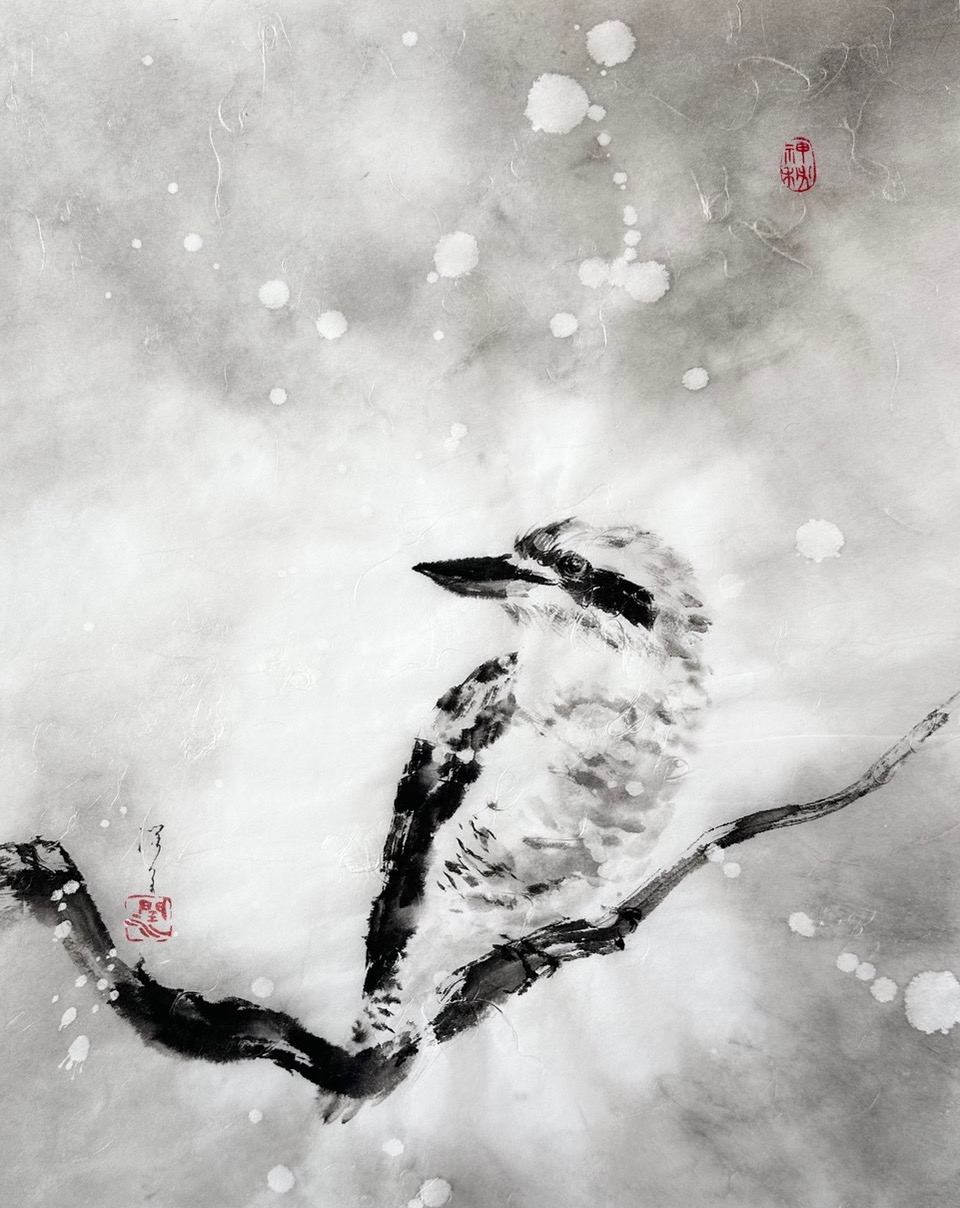
by Priya Mohandoss
So much of our life-force can be discovered through the practice of sumi-e, the Japanese word for ‘black ink painting’. With each application of the brush, this form of art is performed with the use of perception of the object, imparting a sense of calm to the artist while portraying beauty to its viewer.
“I often create landscapes, plants, calligraphy and abstract works and love the stillness before each stroke and the moment when ink meets paper – when something alive and unpredictable appears,” said Junko Azakawa, sumi-e artist of 40 years.
“Different ink tones – dark, medium, and light – symbolise depth, distance, atmosphere, and emotion whereas areas of white space represent silence, possibility, and balance. It too, is as important as the painted areas, allowing the subject to breathe and create harmony in the composition.”
The traditional art of sumi-e has a rich past of Asian heritage. These days it is known as a Japanese art form, however it derived from ancient China during the Tang Dynasty (618-907AD). Then in the 1300s, Buddhist monks took this meditative ritual of ink and white space to Japan where it became greatly influenced by the principles of calligraphy and Zen Buddhism in order to pursue enlightenment through art.
Junko currently teaches sumi-e in Camberwell and, with 20 years of teaching experience behind her, she is able to help students realise their own potential within the context of nature and Japanese philosophy.
“I teach how to hold the brush, basic strokes, brush settings and how to express simple forms such as bamboo, flowers, mountains, fish and birds. Even in a short class, students complete their own artwork and experience the meditative nature of the practice. This encourages calmness, awareness of the present moment, and an appreciation for imperfection.”
During her career span, some of her pieces have been shown at venues such as the Embassy of the Consulate-General of Japan in Melbourne, the National Gallery of Victoria and more locally, at East and West Art in Kew East, with her 2017 exhibition, “Creation in Earth and Water”.
In brief, from sumi-e, we can appreciate its value in the present and embrace the purpose it serves in our lives as a form of belief and illustration.
For further details, refer to the link www.junkoazukawa.com