

Thank you to Jim Pilmer for allowing us to publish his meditations on everyday life. We are sure you will enjoy his quiet, gentle approach to the many challenges we encounter in everyday life.
Jim Pilmer PSM OAM OStJ is an Anglican priest and was senior chaplain to Victoria Police for 13 years. In ‘retirement’ he remains a voluntary chaplain to the Boroondara Police Service Area (PSA) and is honorary State Chaplain to St John Ambulance (Vic).
To read more of his work, click here.
Reflection on the sense of touch
Jim Pilmer PSM OAM OStJ
Touch must rank amongst the most complicated and potentially misconstrued of human senses. On a daily basis the question of when to touch or whether to touch is usually answered for us by referring unwittingly to a built-in regulator. Counsellors find themselves working frequently with issues of non-sexual versus sexual touching. Each has a place in healthy human relationships but both have the potential to create misunderstanding or offence.
Touch is reciprocal. I once read a quote which said: As one touches, one is touched. (That still applies to those who wear protective gloves in their various roles; albeit with some reduction in sensitivity).
In the world of religion, the link between the tactile and the spiritual is a multi-faith phenomenon. Over the centuries so-called ‘people of faith’ worldwide have relied on touch as a means of conveying blessings, healing and forgiveness. In the Christian Church physical touching is widely associated with sacramental acts; an outward and visible sign of something which is inward and spiritual. The laying on of hands, for example, may signify the giving of the Holy Spirit for a specific role, as in the rite of Ordination.
In formal religious rites consent is expressed or implied, but in pastoral (or medical) situations the consent of the recipient is frequently not possible; as when a person is very ill or close to death for example.
Touch-based symbolism is to be found also in civil ceremonies, such as joining hands at the time of making wedding vows. In daily life shaking hands has carried the connotation of a sacred bond for centuries.
In many ways touch is a metaphor for what we wish to happen. For example, placing an arm around a grief-stricken person may well prove comforting but it is also a sign of what we want for them.
Not all touching involves the hands of course. St Paul exhorted Christians to ‘greet each other with a holy kiss’. Until COVID-19 struck, this was still expressed as a kiss in many churches throughout the world.
But in other churches ‘the kiss’ changed long ago to become a more formal act; a handshake or acknowledgement of each other known as The Peace.
Modifying our physical expressions of love, joy, grief and trust during COVID has quite clearly changed our views as regards physical contact; regardless of our beliefs or background. It has certainly involved people of faith in conscious modifications to age-old practices, whether during formal rites or in more casual settings.
Recently an overseas friend ended an email to me by saying ‘Let’s not lose touch.’ I know what he meant but there’s a profound ambiguity there. There is more in a loving touch than words can express and that gift needs to be nurtured at all costs.
In Michelangelo’s fresco painting on the ceiling of the Sistine Chapel the book of Genesis’ narrative of the giving of life to Adam is depicted by the hand of God as he reaches out towards Adam’s fingertips; the spirituality of touch captured in one powerful image.
Jim Pilmer PSM OAM OStJ is an Anglican priest.
Tributes, rituals, ceremonies, acts of respect
Reverend Jim Pilmer PSM OAM OStJ
 Earlier this year I viewed a TV news item about the tribute paid to Lance Appleby who went missing off South Australia’s west coast; the victim of a shark attack. We briefly saw friends and surfing colleagues in wetsuits who had formed a large circle in the water near the site of Lance’s disappearance. Even in that difficult setting appropriate words were expressed and Lance was given a farewell that reflected his love of the surf in that location and people’s respect for him.
I recall another creative act of respect at Leeton in New South Wales some years ago where hot air balloons hung in the sky at daybreak. It was a moving tribute to a much-loved community member who had also died in tragic circumstances and a powerful expression of support for her family and loved ones.
More recently the Row Past for Melbourne Grammar student Edward Millear who died during rowing training was a moving tribute by his fellow rowers.
Rituals and creative ceremonies give us a framework into which we can insert our own thoughts, identify with national, local or family history and from which we can derive comfort. Life’s ritual moments, including the joyful ones, serve to remind us that we live within a time span and that it passes all too quickly. They may be wholly religious, completely secular or a blend of both. They can strike a chord in our hearts or just wash over us. At a funeral, for example, the fact that family and friends gather in the one place at the one time speaks volumes. The sprinkling of earth, the releasing of doves or balloons, each encapsulates a message in a nutshell.
Part of the beauty of such moments is that, as individuals, we can attribute meaning to them within the privacy of our own thoughts and feelings and in the light of our own experience. They touch each of us uniquely because of that. We are not being told what we ought to think or believe and, for that reason, symbolic acts in such a context respect the individual.
For a time, I believed that our community understanding of the value of ceremonial and ritual was being lost. Perhaps in some instances it has faded, but I think now that it’s part of adapting to the multi-faith and multi-cultural community in which we live. Of late there seems to be a growing understanding that ritual and ceremonial observances really do feed a corporate and individual need and that participation in them is a healthy way of expressing unity in diversity. ANZAC observances have been a shining example of this and the deep offence felt at this year’s disruption of Melbourne’s Shrine observance perhaps emphasises the point.
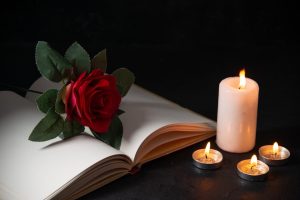 The basic ingredients of grief and loss, remembrance, respect and sympathy may all be represented symbolically. Placing flowers, lighting candles; such things may speak to the soul rather than the intellect. They are valid expressions of faith and hope when words won’t do the job.
Walking Reflection
Jim Pilmer
As I was leaving an office complex after a chaplaincy visit a young man caught up with me near the entrance and said, ‘Excuse me chaplain. Could we go for a walk for a while?’
My initial response was to do a quick calculation of what that would do to my following appointments, and then, after embarrassing myself at the delay, I said ‘Sure. Let’s go’. I knew that Rex was grieving the death of a close friend and colleague in a road crash two weeks earlier and I began to gather my thoughts for the potentially difficult conversation to come.
So, we set off walking briskly along some busy suburban roads, down side-streets, up hills, across a park. I waited for the conversation to begin and the reason for the walk to become clear. I gave occasional opportunities for that to happen but without any luck. I asked how his mate’s family were coping but still no request came for wise words or an explanation of the meaning of life or why tragedies happen.
We continued on, mostly in silence, and at the 20-minute mark I realised that my fitness level no longer qualified me for this aspect of a chaplain’s work. Mercifully his office was in sight and, at the 25-minute mark, we entered the building foyer. At that point I was hoping that Rex would suggest we could find a quiet spot to sit and talk. Instead he patted me on the shoulder and said ‘Thanks mate. That was great’, and headed back to his office.
The Greek physician Hippocrates was of much the same opinion some 400 years BC when he stated that ‘Walking is man’s best medicine’. To walk in the company of others adds a therapeutic dimension where conversation is spontaneous, open, or as with my experience, almost non-existent but constantly on offer.
But it is the walk itself, walking together, that not only symbolises interpersonal support but makes it so beneficial in practice. Terri Irwin AM, wife of the late conservationist Steve Irwin, has said ‘Your grief path is yours alone and no one else can walk it’. That’s true but we can walk with others on some parts of the journey.
After Rex and I parted, I realised that I had been given a metaphor for being of a support to others in a range of circumstances. Be prepared to walk beside them, not necessarily trying to emulate the ‘in their shoes’ adage. Don’t presume to know what they need along the way and don’t always expect to see the end result of the walk.
Communication is more than words
Jim Pilmer
Jenny was a super-efficient Personal Assistant to the director of a large company. Staff found her hard to fathom. Some days she looked buoyant, on others hunched over and sad. She always refused invitations to Friday drinks after work and always without stating a reason. Around the office Jenny was intermittently aloof. Her body language seemed to say, keep your distance. Assumptions were made, conclusions reached. They were that Jenny thought she was in some way superior to everyone else and didn’t mix for that reason.
Then one morning Jenny didn’t show up for work. About mid-morning the boss announced to the staff that Jenny was in hospital, having been attacked by her husband the night before. It was subsequently discovered that his controlling behaviour was so rigid that something as normal as attending Friday drinks would have implied that she was playing up behind his back. The so called body language experts got it wrong. Her husband’s voice in the background was always saying: Don’t get close to anyone, or else!
In a very different context is the story of Steve. His next door neighbour, Ally, a single mother, injured her back and was house-bound for almost 4 weeks. Ally’s daughter, Jess, was a mad keen rower and Ally’s situation looked like putting an end to her daughter’s early morning practice with the school team. Steve, still running his own business, got up at 5am twice a week to drive Jess to her clubhouse. The language of getting his body into gear for others gave a fine example to Jess and no doubt contributed to Ally’s recovery.
Graham, a road trauma victim, and permanently in a wheelchair, is completing a Certificate Course in Disability Studies at a TAFE College. His partial lack of the usual body movements is misconstrued by some but he’s one genuine young man. You can read it in his face and in his eye contact. He’s not sure where the course will take him but I’m sure that the messages he sends, overtly and subliminally, will prove of enormous help to others down the track.
Of course, it’s all very well to try and ‘read’ others but what we convey by our own smiles, gestures, actions and general demeanour plays a huge part in whether we make people feel understood, respected or included. They need to be able to read us as well, whether in the course of an ongoing caring commitment or a fleeting encounter. We are all capable of making assumptions and jumping to conclusions.
Nations can exhibit body language as can local communities, the corporate world and individuals. If we expand our understanding of the ways we are perceived and of the many ways in which we communicate we can foster healing in ways which words cannot.
This article was first published in Eastsider News. Edition 20, October 2023